
Understanding The Aircraft Management Recipe
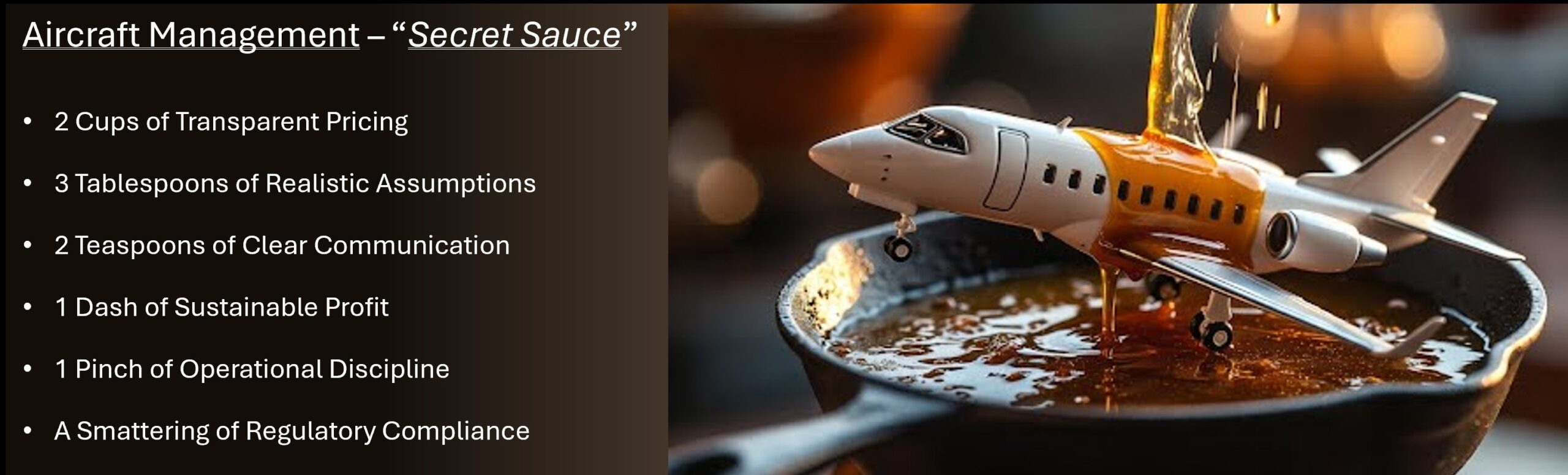
Prep-Work And Understanding The Ingredients Is Key
Clarity Over Cleverness
In aircraft management and charter, the most durable arrangements rarely depend on a secret sauce. They depend on clarity, as clever may yield new business, but clarity drives repeat business.
Owners often enter management discussions and management companies often pitch a “secret sauce” — a way to offset costs dramatically, monetize unused aircraft time, preserve perfect availability, minimize administrative burden, and still receive concierge-level service. Management and charter companies, eager to win business, may be tempted to encourage that expectation.
That is where frustration begins.
Sustainable Economics
A supportable aircraft management relationship is not built on optimistic projections or creative economics. It is built on transparent pricing, realistic utilization assumptions, operational discipline, and a management company that is permitted to earn a sustainable profit. If the manager cannot make money honestly, it will make money somewhere else — through markups, opaque vendor relationships, maintenance handling, fuel programs, charter splits, crew administration, or service compromises.
Aircraft are financially unforgiving assets. Charter demand is uneven. Maintenance is episodic and expensive. Crew retention requires competitive compensation. Insurance markets change. Regulatory compliance is non-negotiable. Dispatch volume and consistency depends on your financial investment, long before a trip is flown. A management company that promises unusually low fees and unusually high charter revenue is often pitching a secret sauce that results in a potentially putrid meal.
Three Common Warning Signs
Owners should be wary of three things: guaranteed outcomes, vague pricing, and excessive creativity.
Guaranteed charter revenue can distort expectations. Charter may help defray costs, but it is not magic. More charter means more cycles, more wear, more scheduling conflicts, more cleaning, more maintenance exposure, and potentially more owner inconvenience.
Vague pricing is equally troublesome. A good management proposal should clearly explain fixed fees, variable costs, administrative charges, charter revenue splits, maintenance oversight fees, fuel purchasing practices, crew costs, hangar arrangements, and vendor markups. Transparency does not mean the cheapest structure. It means the owner understands who is being paid, for what, and why.
Overly creative structures can also create tax, FAA, insurance, and operational problems. Dry leases, reimbursement arrangements, related-party use, charter availability, and personal/business allocation all require careful coordination. A clever structure that ignores operational reality can become expensive and as iterated above, frustrating, very quickly.
Identifying Good Managers
The best aircraft managers are not chefs with a secret sauce. They are disciplined operators. They communicate early, and may over-communicate at times. They price honestly. They protect safety margins. They tell owners what they need to hear, not what they want to hear.
So the “secret” is that there is no secret sauce.
A successful aircraft management relationship is a commercial partnership. The owner deserves transparency and accountability. The manager deserves a fair return for assuming complex operational responsibility. When both sides acknowledge that reality at the beginning, the relationship has a much better chance of being safe, compliant, financially rational, and free of avoidable disappointment.
Beware of the recipe that has never been attempted before. When it comes to aircraft management, there is nothing wrong with well executed steak and potatoes.